
When assessing potential risk, the following factors should be taken into consideration:
Co-occurrence: The simultaneous appearance of multiple warning signs.
Suddenness: Rapid and abrupt behavioural changes without an identifiable cause.
Deviations from Baseline: Marked departures in behaviour or emotional state from the child’s established personality.
Children possess neither the developmental capacity nor the legal standing to consent to sexual activity with adults. A child’s lack of resistance or failure to verbalise refusal does not constitute consent.
Child sexual abuse does not invariably involve physical force. It frequently occurs through the establishment of trust, power imbalances, the bestowal of gifts, or gradual grooming processes, leaving the child unaware that they are being abused.
Under Section 277 of the Thai Penal Code, sexual assault against a child under the age of fifteen constitutes a criminal offence, regardless of whether the child ostensibly consented. Nevertheless, this legal age threshold remains below international standards, which aim to protect all individuals under eighteen.
Legal and moral responsibility resides solely with the perpetrator, never the child.
International research consistently demonstrates that approximately 90% of children who experience sexual abuse are abused by someone familiar to them.
~30% are family members.
~60% are individuals trusted by the family, such as relatives, neighbours, teachers, sports coaches, or religious leaders.
Perpetrators are not exclusively adults; older children or adolescents may also commit these acts.
Consequently, instructing children merely to “beware of strangers” is grossly inadequate and risks obscuring threats in close proximity.
According to Freyd’s (1996) research on Betrayal Trauma, abuse perpetrated by an individual whom the child loves, relies upon, or trusts is associated with:
Deeper Psychological Trauma: Arising not only from physical harm, but from a profound violation of trust.
Complex Psychological Defences: Significantly linked to emotional detachment, dissociation, and Complex Post-Traumatic Stress Disorder (C-PTSD) resulting from chronic trauma.
Barriers to Disclosure: Children encounter severe difficulties in disclosing the abuse, often trapped by fear—such as fear of disbelief or ongoing dependence on the perpetrator for daily survival.
Distorted Perception of Relationships: Leading to confusion between “love” and “abuse,” which causes long-term disruption to their capacity to form healthy interpersonal relationships in adulthood.
ㅤㅤㅤㅤㅤㅤㅤㅤ
 ㅤㅤㅤㅤㅤㅤㅤㅤ
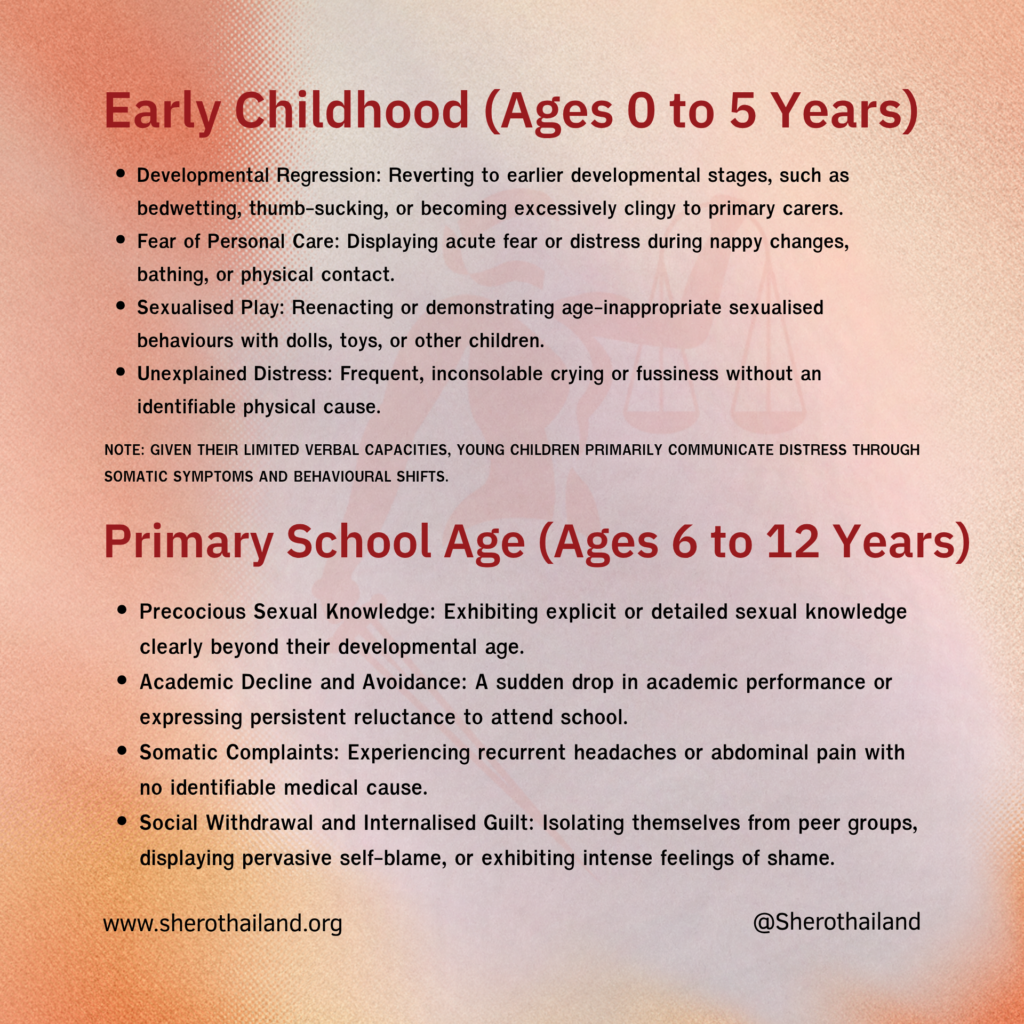
Age-Inappropriate Sexualised Behaviour: Exhibiting sexual knowledge, language, or behaviours beyond their developmental stage.
Abnormal Communication in Play and Art: Conveying sexual themes or violence through play, role-play, or artwork.
Sudden Avoidance: Expressing abrupt reluctance or fear regarding specific individuals, places, or activities without a clear reason.
Developmental Regression: Reverting to behaviours characteristic of younger children, such as bedwetting, thumb-sucking, or heightened clinginess.
Altered Perceptions of Privacy: Displaying intense distress or resistance when changing clothes or undergoing physical examinations in routine settings (e.g., swimming lessons).
Elopement or Fear of Home: Running away from home or exhibiting severe anxiety at the prospect of returning home.
Unexplained Possessions or Secrecy: Possessing unexplained gifts or money while attempting to conceal them or maintain secrets.
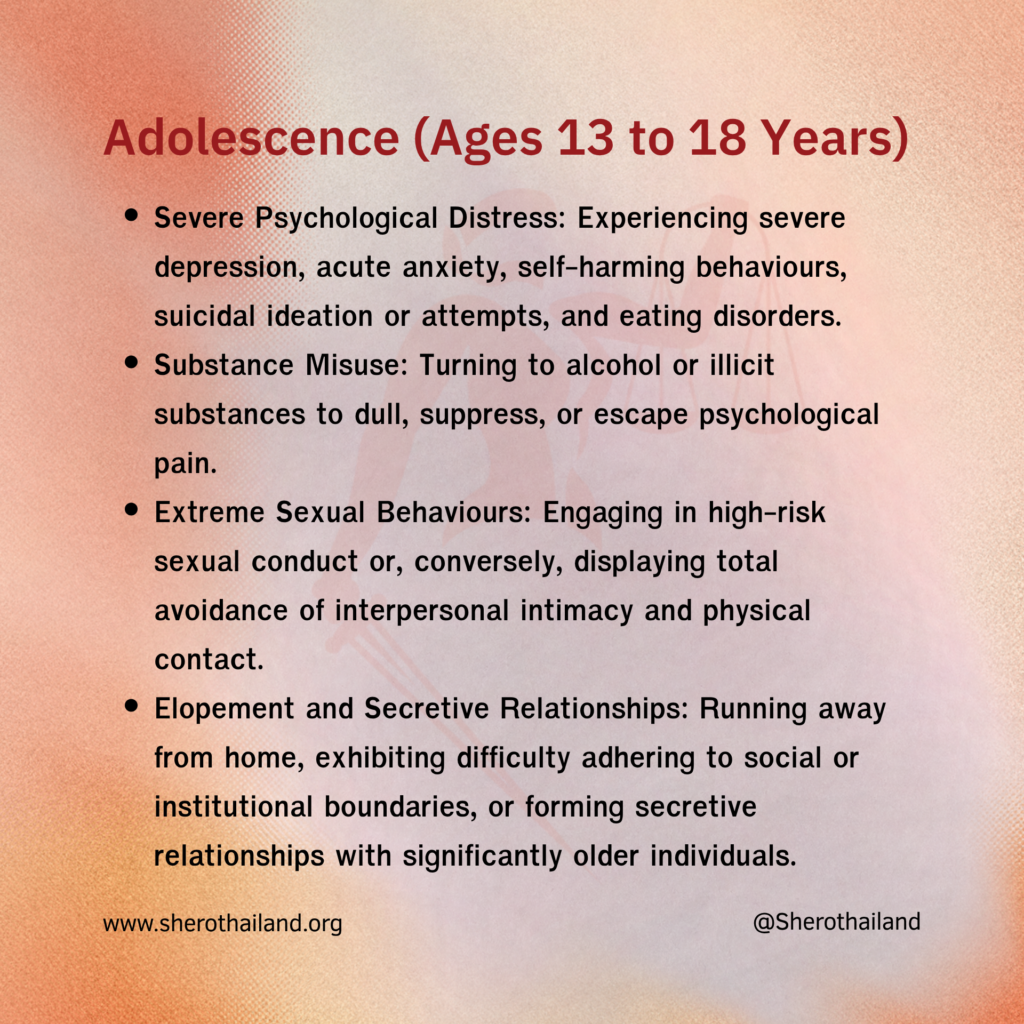
Abrupt Mood Alterations: Becoming socially withdrawn, unusually quiet, excessively anxious, or displaying uncharacteristic irritability.
Newly Emergent Fears: Developing intense fears of previously tolerated situations (e.g., darkness, being left alone, or specific individuals/groups).
Sleep Disturbances: Experiencing insomnia, nightmares, waking in distress, or exhibiting fear prior to bedtime.
Deteriorating Psychological Well-being: Displaying signs of depression, feelings of worthlessness, or self-loathing (e.g., describing themselves as “dirty” or a “bad child”).
Dissociation: Appearing visibly spacey or psychologically detaching from their surroundings to escape distress.
Decline in Academic Performance and Focus: Experiencing a sudden drop in academic marks or a diminished capacity to concentrate.
Excessive Compliance and Hypervigilance: Demonstrating abnormal obedience, constantly trying to please adults, or exhibiting hyper-awareness and apprehension regarding the adults around them.
Note on Adolescents: Aggressive or defiant behaviour in teenagers is often misidentified as mere conduct disorder. In reality, these actions may represent distress signals and cries for help. Responding with punitive measures risks closing avenues for safe disclosure.
ㅤㅤㅤㅤㅤㅤㅤㅤ
Initial Disclosure: When distressed, children often disclose information incrementally to test an adult’s response. A calm, non-judgmental, and empathetic initial reaction is critical to reassuring the child and encouraging full disclosure.
Emotional Crisis: Acute trauma, intense fear, shame, and a propensity toward self-blame.
Disruption to Daily Functioning: Severe sleep disturbances, impaired academic performance, and difficulty integrating socially.
Chronic Mental Health Conditions: High risk of depression, PTSD, self-harm, and suicidality.
Somatic Health Deterioration: Aligned with Adverse Childhood Experiences (ACEs) research, childhood trauma significantly increases adult susceptibility to physical illnesses (e.g., cardiovascular disease, autoimmune disorders) due to chronic toxic stress.
Relational Impairment: Severe impairment in establishing trust, vulnerability, and secure attachments.
Revictimisation: Heightened risk of experiencing subsequent abuse in adulthood due to compromised risk-assessment mechanisms.
Statistically Higher Prevalence: UNICEF estimates that approximately 1 in 5 girls globally experience sexual violence before age 18 (compared to 1 in 7 boys).
Internalising Behaviours: Trauma often manifests inwardly through depression, acute anxiety, self-harm, and eating disorders.
Societal Stigma: Cultural emphasis on “purity” frequently leads to victim-blaming and secondary trauma from societal prejudice.
The Barrier of Toxic Masculinity: Boys often delay disclosure due to shame, fear of appearing weak, or anxiety regarding perceptions of their sexual orientation.
Externalising Behaviours: Trauma typically manifests as aggression, substance misuse, or high-risk conduct, causing society to mislabel them as “delinquents” rather than victims in distress.
Societal Myths: Misconceptions that “boys cannot be abused” or “boys can defend themselves” frequently lead adults to overlook clear warning signs.
Heightened Vulnerability: LGBTQ+ youth face elevated risks of abuse and unique disclosure barriers, including fear of forced outing regarding their gender identity or sexual orientation, or fear of identity-based rejection.
ㅤㅤㅤㅤㅤㅤㅤㅤ
ㅤㅤㅤㅤㅤㅤㅤㅤ
Remain Calm and Attentive: Regulate facial expressions and emotional reactions. Listen patiently, demonstrating belief and support.
Reassure the Child: Clearly and warmly state: “This is not your fault.”
Avoid In-Depth Interrogation: Do not cross-examine the child. Detailed interviews should be conducted strictly by qualified child protection professionals to avoid re-traumatisation and preserve evidentiary integrity.
Verbatim Documentation: Record the child’s exact words verbatim without interpretation, speculation, or embellishment.
Report to Safeguarding Authorities: Immediately notify designated child protection services.
📞 1300: Social Assistance Centre (24 Hours)
📞 1387: Childline Thailand Foundation
WHO (2017): Responding to children and adolescents who have been sexually abused: Clinical guidelines.
UN CRC: General Comment No. 13 (2011).
UNICEF (2020): Action to End Child Sexual Abuse and Exploitation.
Freyd, J. (1996): Betrayal Trauma: The Logic of Forgetting Childhood Abuse.
Finkelhor, D., & Shattuck, A. (2012): Characteristics of crimes against juveniles.
Felitti, V. et al. (1998): ACE Study, American Journal of Preventive Medicine.
NSPCC: Signs and indicators of child sexual abuse.
Darkness to Light: Stewards of Children.
Thai Penal Code: Section 277.
Child Protection Act B.E. 2546 (2003).