
ㅤㅤㅤㅤㅤㅤㅤㅤㅤㅤㅤㅤ
Content Warning: This post contains references to child sexual abuse and domestic violence.
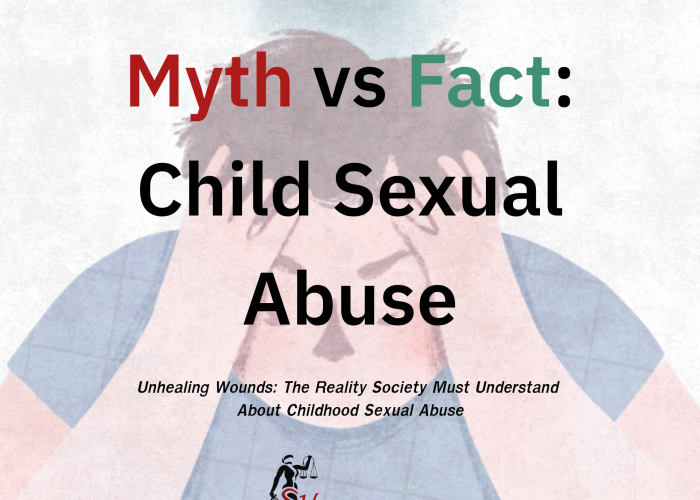
❌ Myth: Child sexual abuse is a rare occurrence.
✔ Fact: Child sexual abuse is not rare. A significant number of children experience sexual abuse before the age of 18, but many cases are never disclosed or reported because this type of violence usually happens in secret and is kept hidden.
❌ Myth: Children are usually abused by “strangers”.
✔ Fact: Most children are abused by someone they know or trust, such as family members, relatives, or individuals within their “circle of trust”.
❌ Myth: Child sexual abuse is usually an isolated, one-off incident.
✔ Fact: Child sexual abuse rarely happens just once or as a single isolated incident. Many perpetrators engage in grooming—gradually building trust, controlling, and manipulating the child as well as those around them—so they can continue the abuse without being exposed.
❌ Myth: Children may be partly to blame for the abuse or may have “consented”.
✔ Fact: Children cannot give consent to sexual abuse, meaning a child is never responsible for the violence inflicted upon them. Full responsibility always lies solely with the perpetrator.
Sexual abuse against children, especially when perpetrated by family members or trusted individuals, is one of the most severe and devastating forms of sexual violence. This is because perpetrators do not merely violate a child’s body; they destroy the child’s trust, sense of safety, and long-term psychological development. In other words, these impacts can follow them well into adulthood.
A significant number of children grow up carrying deep trauma from being harassed, coercively controlled, or sexually exploited by the very people they should have been able to trust the most. These wounds do not simply heal the day the abuse stops. Instead, they continue to affect their mental health, emotional well-being, relationships, and life choices, while eroding their self-worth throughout their lives.
Coercing and controlling a child to submit to sexual acts—regardless of the nature of the relationship—is a grave violation of basic human rights. A child who endures sexual abuse is dehumanised, reduced to a mere object for the perpetrator’s gratification. Their feelings, fears, and boundaries are rendered meaningless, and they are forced to submit to an unyielding power dynamic. Such violence harms far more than just the physical body; it corrodes a child’s dignity, safety, and core human worth at the deepest level.
At the same time, society must not place the burden on survivors to prove their own pain—whether by questioning their memories accusatorily, asking things like “Why are you only speaking up now?”, or judging their credibility against the notion of an “ideal victim”. As we have consistently emphasised, many survivors require a long time before they can fully process or speak about what happened to them.
What society ought to do is prioritise the dignity, safety, and rights of survivors first and foremost—whether they are children today or adults who were abused during childhood. We must listen to their stories without minimising their experiences, and without dismissing what they faced as a minor issue, a matter of the past to be forgotten, or “just how things were back then”. Ignorance, the normalisation of violence, and protecting perpetrators in the name of family, reputation, or the passage of time all contribute to perpetuating a culture of abuse. This paves the way for violence to recur for future generations and deters countless survivors from seeking help or speaking out about what they have endured since childhood.
ㅤㅤㅤㅤㅤㅤㅤㅤㅤㅤㅤㅤ
ㅤㅤㅤㅤㅤㅤㅤㅤㅤㅤㅤㅤ
What Should We Do When Someone Close to Us Endures Sexual Abuse?
Listen with heart and without judgment
Prioritise safety above all else—both physical and psychological. If immediate assistance is needed, contact the One Stop Crisis Centre (OSCC) at public hospitals nationwide, which provides comprehensive medical, psychological, and social support.
In cases involving children or young people (under 18 years of age), the case falls under child protection laws. You can call 1387 (Childline Thailand Foundation), the Child Rights Protection Centre Foundation, or the provincial Ministry of Social Development and Human Security (MSDHS) for advice and support.
Assess the situation and plan the next steps together, always keeping the survivor’s decisions at the core of every action.
National Office for Child Safety. “Myths and Misconceptions.” Australian Government. https://www.childsafety.gov.au/about-child-sexual-abuse/myths-and-misconceptions.
Aubert, Veronique, and Alison Holder. Unspeakable Crimes Against Children: Sexual Violence Against Children. Save the Children, 2013. https://resourcecentre.savethechildren.net/document/unspeakable-crimes-against-children-sexual-violence-against-children/.
Whealin, Julia, and Erin Barnett. “Child Sexual Abuse.” PTSD: National Center for PTSD, U.S. Department of Veterans Affairs. Last modified March 25, 2025. https://www.ptsd.va.gov/professional/treat/type/sexual_abuse_child.asp.