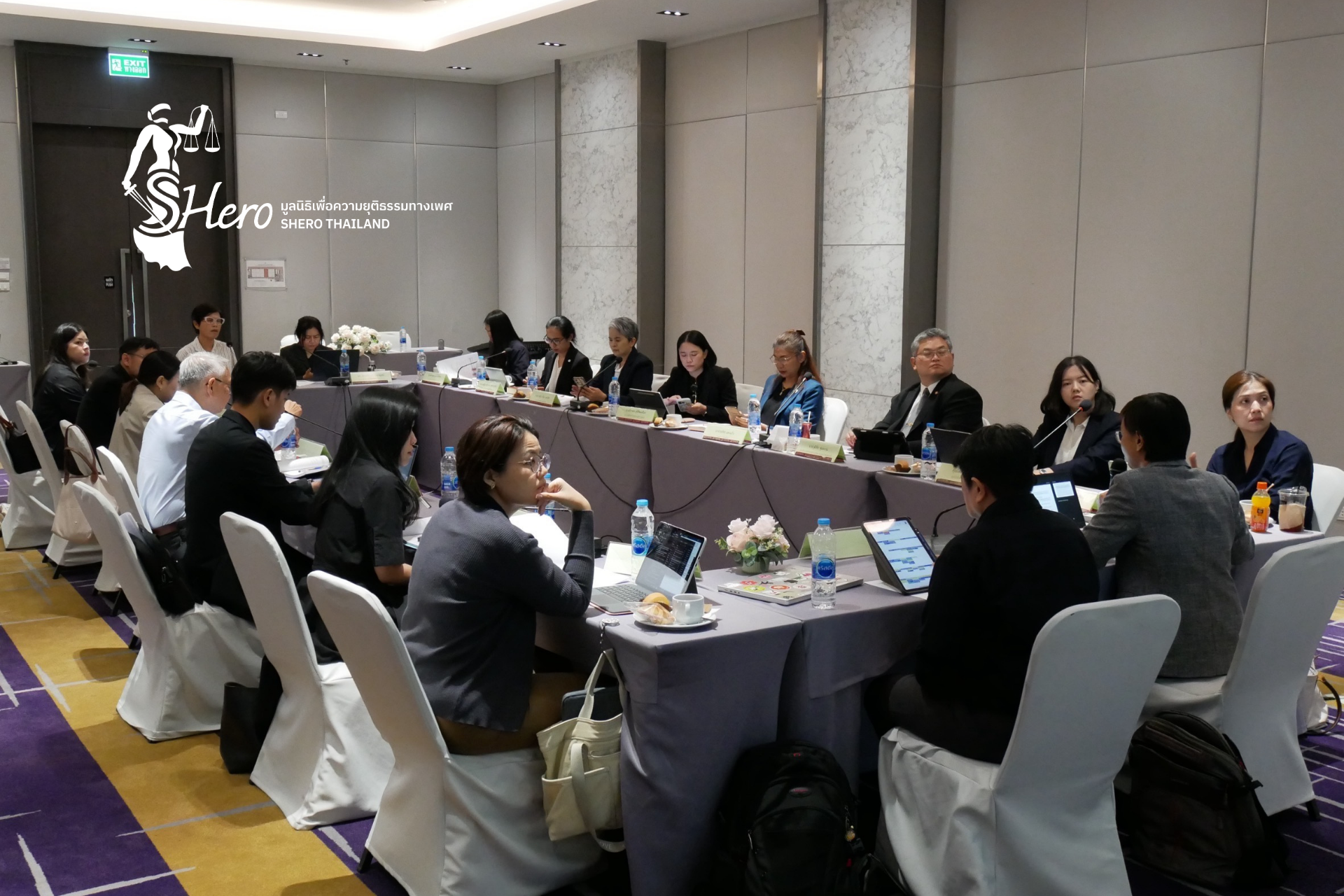
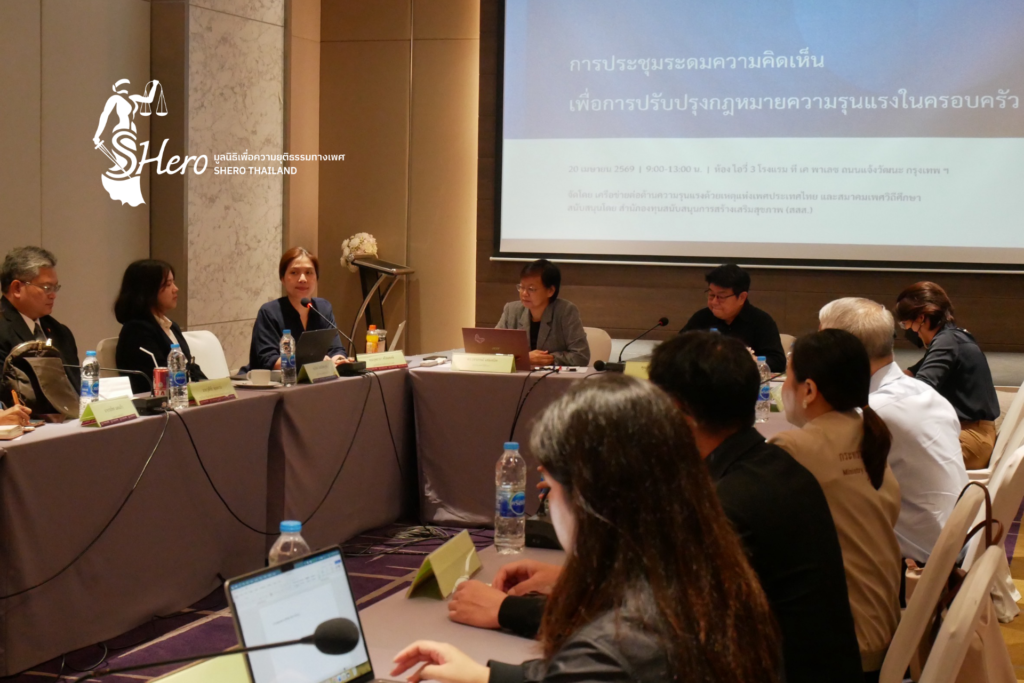
On 20 April 2026, SHero Thailand participated in presenting recommendations and facilitating a brainstorming session aimed at reforming domestic violence legislation. The event was organised by the Thailand Coalition Against Gender-Based Violence and the Association for Sexuality Studies. As a results, the collaborative discussions between civil society organisations and state practitioners reflected a shared commitment to developing legislation that truly addresses the realities of violence within contemporary society.
As one of the organisations actively involved in drafting the civil society version of the amendments to the domestic violence protection law, SHero emphasised that the legislation must possess a clear and unequivocal intent to prioritise the protection of victims. This must be coupled with the design of appropriate measures that align with the actual nature of the violence perpetrated. Most notably, existing case management mechanisms must not be abolished or replaced by family rehabilitation measures; these interventions serve fundamentally different purposes and functions, and should instead be implemented concurrently in a well-balanced manner.
ㅤㅤㅤㅤㅤㅤㅤㅤㅤㅤㅤㅤㅤㅤㅤㅤㅤㅤㅤ
Furthermore, introducing family counselling or mediation as an early-stage intervention carries high risks and diverges from international standards. Such premature measures risk reinforcing the dominance of the perpetrator and perpetuating the power imbalance between the parties involved. There is also an urgent need to establish explicit victim protection measures, which must be systematically separated from behavioural modification programmes designed for perpetrators. In terms of criminal law, domestic violence offences should be classified as non-compoundable public offences, with statutory penalties structured in strict alignment with criminal law principles, thereby ensuring that victim protection is comprehensive, precise, and effectively enforceable.
ㅤㅤㅤㅤㅤㅤㅤㅤㅤㅤㅤㅤㅤㅤㅤㅤㅤㅤㅤ
Concurrently, the terminology within the current domestic violence legislation remains a point of ambiguity. In the English context, the word ‘domestic’ does not exclusively denote the conventional ‘family’ unit; rather, it encompasses a broader spectrum of ‘close or intimate relationships’, including family members, romantic partners, and others. Consequently, because the definition of ‘family’ under Thai law fails to keep pace with international standards, a significant number of romantic partners and individuals in other forms of close relationships—whether unmarried or not residing under the same roof on a daily basis—are inadvertently excluded from the scope of legal protection, leaving them without recourse. In reality, violence within a relationship is determined neither by residential arrangements nor by formal legal status. Instead, its root cause stems fundamentally from an ‘imbalance of power’, wherein one party seeks to exert control or dominance over the other.
Global statistics indicate that approximately one in three women have experienced violence, predominantly perpetrated by an intimate partner. Furthermore, the prevalence of such violence within the LGBTQIA+ community remains deeply concerning.
ㅤㅤㅤㅤㅤㅤㅤㅤㅤㅤㅤㅤㅤㅤㅤㅤㅤㅤㅤ
Therefore, if the law continues to focus strictly on a narrow definition of ‘family’ or confines its scope solely to individuals cohabiting as husband and wife, it risks excluding romantic relationships from legal protection. In practice, this would mean that intimate partner violence—the very core of domestic violence—remains insufficiently protected under the Thai legal framework.
ㅤㅤㅤㅤㅤㅤㅤㅤㅤㅤㅤㅤㅤㅤㅤㅤㅤㅤㅤ


 ㅤㅤㅤㅤㅤㅤㅤㅤㅤㅤㅤㅤㅤㅤㅤㅤㅤ