

Our Stories

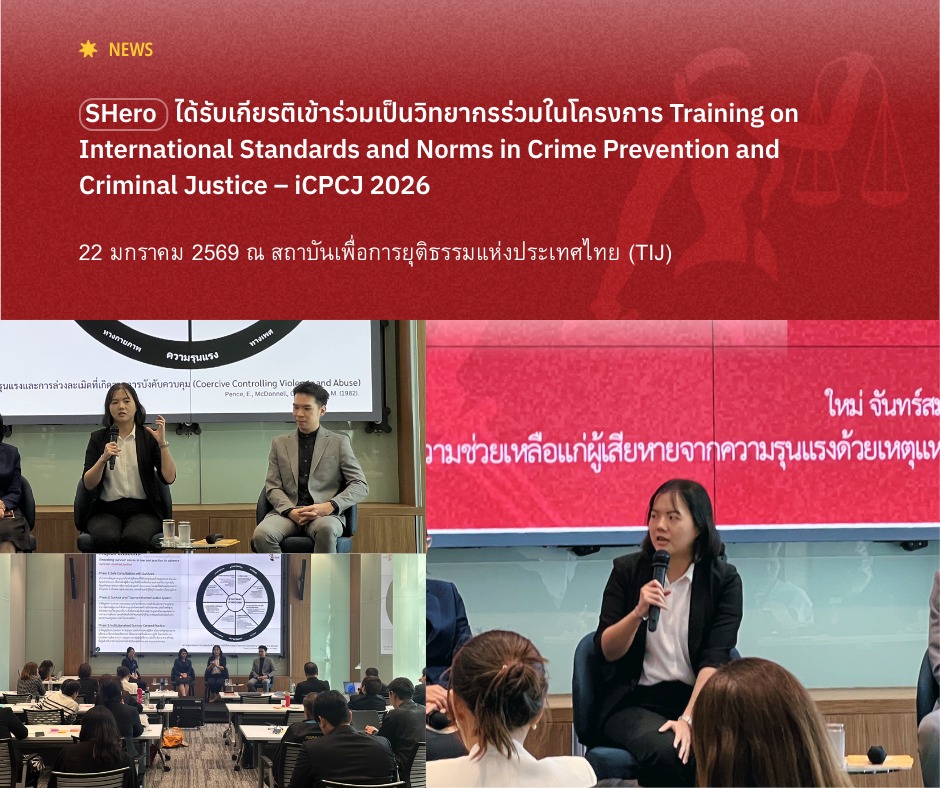
SHero Thailand was honored to serve as a guest speaker for the ‘Training on International Standards and Norms in Crime Prevention and Criminal Justice – iCPCJ 2026’ program.

On January 22, 2026, SHero Thailand was honored to participate as a co-speaker in the “Training on International Standards and Norms in Crime Prevention and Criminal Justice – iCPCJ 2026,” organised by the Thailand Institute of Justice (TIJ). The topic was “People-centered Justice,” with participants from justice-related agencies in both the public and private sectors.
During the lecture, SHero Thailand proposed a development approach for the “Voices of Survivors” project to promote Survivor-centered justice. This involves collecting data on violence from survivors nationwide, including marginalised groups such as migrant workers and survivors from vulnerable areas, to conduct systemic analysis and drive policy changes. Additionally, it aims to design tools and practical guidelines for use in the justice process.
SHero emphasized that while the “People-centered” concept is an important framework for creating equal access to justice, for cases of violence and sexual abuse—which have specific sensitivities—using a Survivor-centered approach alongside a Trauma-informed approach is essential. This ensures the justice process considers the safety, dignity, and decision-making power of survivors, as well as avoids re-traumatisation.
Furthermore, the session reflected on challenges survivors face when entering the justice system, such as resource gaps, institutional limitations, laws that do not align with the context of violence cases, attitudes and biases of service providers, and the specific conditions of survivors in different contexts, such as the legal status of refugees or migrant workers.
Regarding practical operations, SHero highlighted the importance of Trauma-informed interviews. These are interviews that consider psychological impacts by adhering to principles of safety, building trust, respecting survivor decisions, providing choices, working collaboratively, and empowerment, ensuring that data collection and legal proceedings do not become acts of repeated violence.
Finally, SHero reiterated that survivors do not choose to be survivors. A truly people-centered justice process must be designed with consideration for the nature of the case, sensitivity, and the specific needs of survivors to ensure justice that is safe, dignified, and truly accessible.