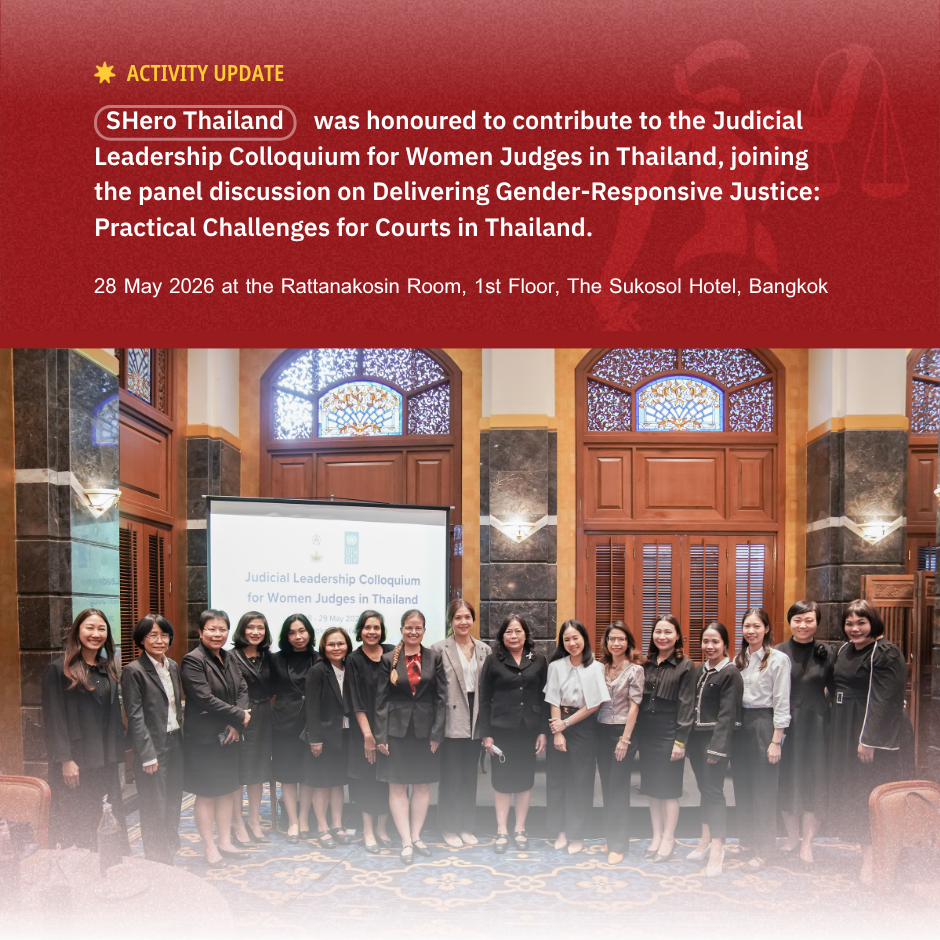
SHero Thailand was honoured to contribute to the Judicial Leadership Colloquium for Women Judges in Thailand on 28 May 2026, joining the panel discussion on Delivering Gender-Responsive Justice: Practical Challenges for Courts in Thailand.
.
During the session, SHero founder
Busayapa Srisompong shared reflections drawn from SHero’s work alongside survivors of gender-based violence (GBV), particularly women, migrant, refugee, and stateless survivors navigating the justice system.
.
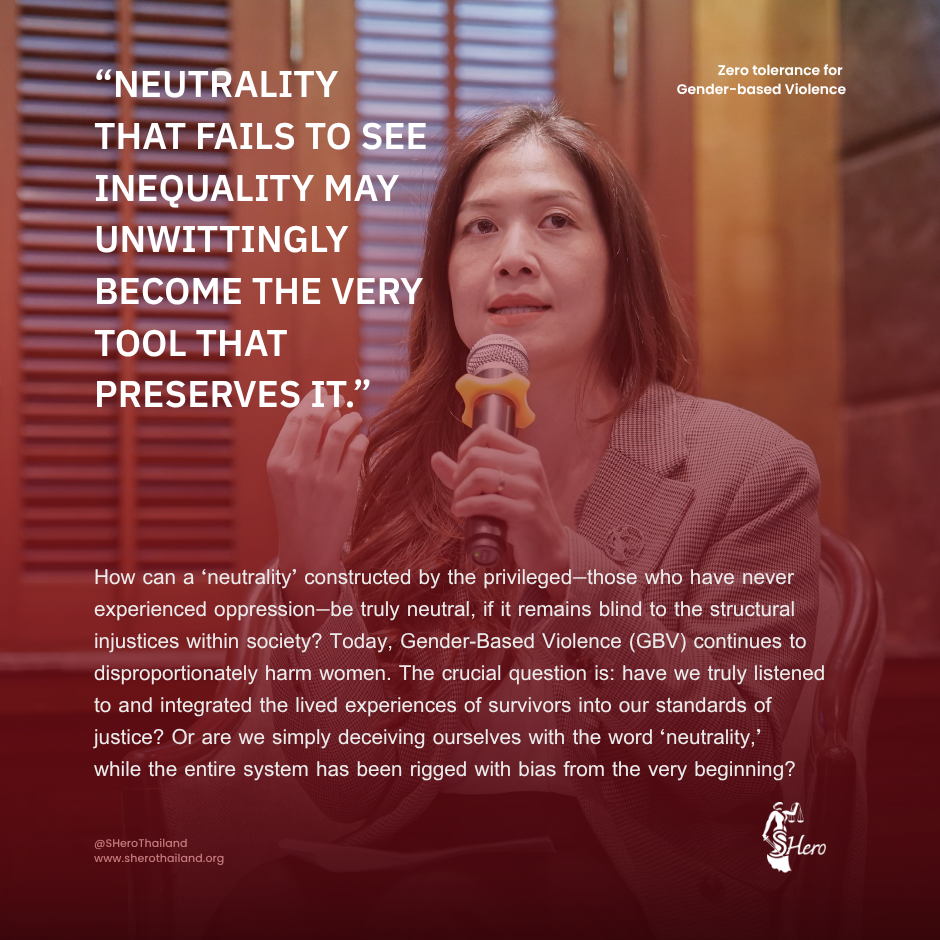
The discussion invited participants to reflect on the concept of neutrality within justice systems. Neutrality that fails to recognise structural inequality may unintentionally reinforce it. While GBV affects people of all genders, women remain disproportionately affected and men remain the primary perpetrators. Building gender-responsive justice therefore requires a deeper understanding of power relations, inequality, and the lived realities of survivors.
.
.
SHero also highlighted the importance of understanding sexual violence through the lens of power, coercion, and consent, as well as recognising forms of abuse that may not yet be fully reflected in legal language and frameworks. When experiences of harm cannot be adequately named or recognised, they risk remaining invisible within justice processes.
.
SHero also reflected on the importance of women’s leadership within justice institutions, inviting participants to consider that progress should not be measured solely by the number of women entering the profession. While women now make up a significant proportion of the judiciary, an important question remains: why do relatively few women reach senior leadership positions, and what structural factors continue to limit their advancement? Equally important is what happens when women do reach positions of leadership. Can they use their authority and influence to transform institutional culture, power structures, and systems in ways that create greater opportunities and more equitable pathways for future generations? At the same time, judges — particularly women judges — should be supported in their wellbeing, leadership development, and inner resilience so that they can sustain meaningful institutional change over the long term.
.
SHero believes that gender-responsive and survivor-centred justice begins with listening to survivors’ experiences and recognising them as essential evidence for improving laws, policies, and justice institutions. Justice systems that are safe, accessible, and grounded in human dignity are fundamental to preventing and responding to gender-based violence.
.
We extend our sincere appreciation to UNDP, the Court of Justice of Thailand, UN Women Asia-Pacific, Asian Development Bank, and UNODC for creating this important space for dialogue, reflection, and collective action.
.